
1. Why conventional transfer can be a problem
A closed-transition ATS is used where even a brief interruption of 4–6 ms during transfer between sources is a problem: a UPS may switch to battery operation, a control system may stop, a controller may report a fault, and process equipment may undergo an unwanted restart.
A conventional ATS follows a simple sequence: the load is first disconnected from one source and then connected to the other. This is a safe and appropriate arrangement for many facilities, but it always includes a moment when the load is briefly without power.
Most ATS units without a fully developed arc-extinguishing system cannot transfer instantaneously. Time is needed to safely open the power contacts, extinguish the arc and only then connect the other source. In practice, this interruption may be approximately 3–6 seconds.
High-speed ATS units using switches with arc chutes operate much faster: transfer can take up to 100 ms. However, even this interruption may be undesirable for some critical equipment: a UPS may detect a voltage dip, a control system may report a fault, and process equipment may restart.
A closed-transition ATS addresses this differently: instead of simply trying to open and close the contacts quickly, it detects a brief window of acceptable phase coincidence between the sources and performs a make-before-break transfer.
2. The key principle: the ATS detects phase coincidence
A closed-transition ATS does not synchronise the power sources. It does not adjust the generator to match the utility supply or control the generator engine speed in this mode.
Its task is different: the ATS controller continuously evaluates the two available sources and waits until their voltage, frequency and phase angle happen to be sufficiently close.
Put simply, the ATS detects a brief window when the utility supply and standby source momentarily fall within the permissible synchronism limits. At this point, the ATS can briefly parallel the sources and transfer the load without a noticeable interruption.
The key principle is to detect the moment when source parameters permit safe load transfer without loss of power, rather than actively synchronising the sources.
3. How uninterrupted transfer works
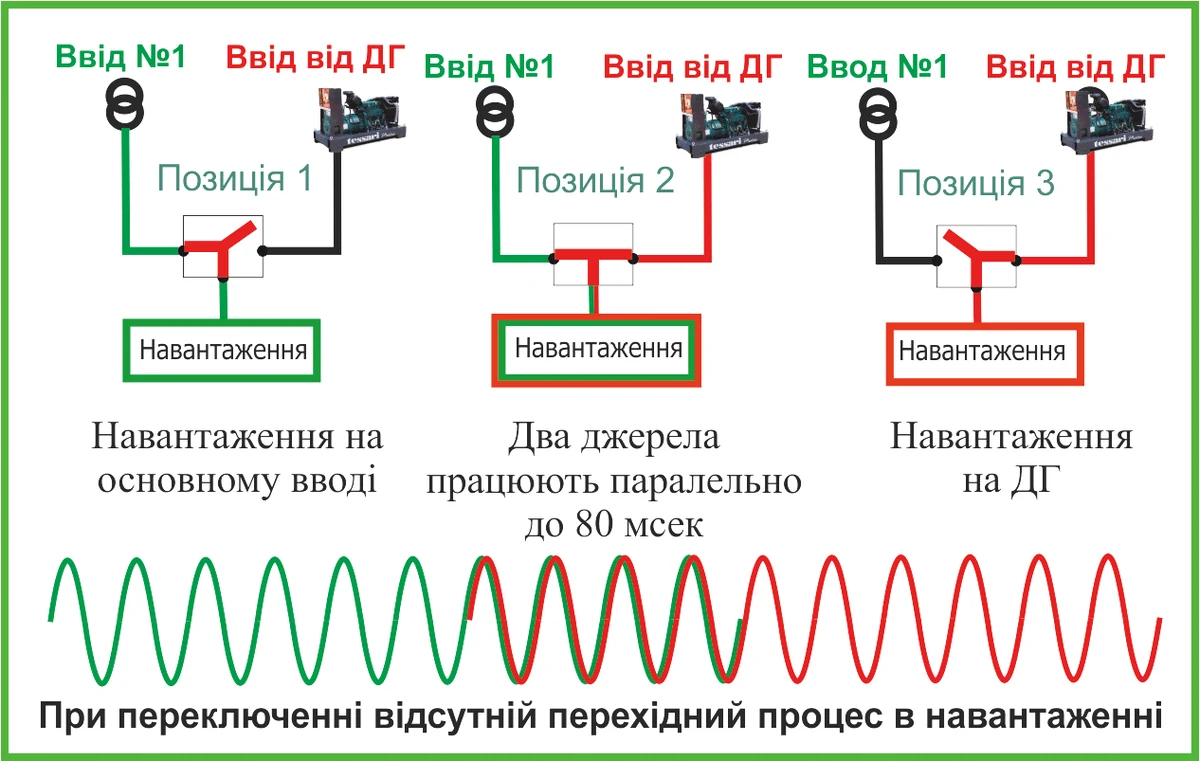
In this mode, transfer follows the make-before-break principle.
This means that, before disconnecting the first source, the ATS connects the second source for a very brief period. The sources momentarily overlap, after which the first source is disconnected and the load remains energised.
In simplified terms, the sequence is as follows:
- the load is supplied by the first source;
- the ATS monitors the second source parameters;
- when voltage, frequency and phase angle fall within the permissible window, the ATS briefly closes the connection to the second source;
- both sources are connected in parallel for a very brief period;
- the first source is disconnected;
- the load continues to receive power from the second source without a noticeable interruption.
Crucially, the overlap must be very short and strictly controlled. This is not sustained parallel operation of the sources, but only the brief interval required for uninterrupted load transfer.
4. What the ATS checks before transfer
Before a closed-transition transfer, the ATS controller must establish that momentary paralleling of the sources is permissible.
The principal parameters monitored are:
- voltage present at both sources;
- voltage difference;
- frequency difference;
- relative phase angle;
- correct phase sequence;
- readiness of the power transfer switch;
- permission to transfer in the selected direction;
- absence of fault conditions.
If the parameters do not meet the required conditions, closed-transition transfer is not performed.
In that case, the ATS reverts to the safe conventional mode, with an interruption of supply. This is what distinguishes a properly engineered closed-transition ATS from an unsafe arrangement that simply connects two sources together to see what happens.
5. Why this is different from sustained generator paralleling with the utility
A closed-transition ATS should not be confused with sustained parallel operation of a generator and the utility supply.
During sustained parallel operation, the generator is synchronised with the utility supply, and its frequency, voltage, active power and reactive power are controlled. Such a system requires dedicated control logic, protection, regulators and coordination of operating modes.
A closed-transition ATS works differently. It does not keep the generator connected in parallel with the utility for an extended period. It permits only momentary source overlap during transfer.
- Closed-transition ATS operation is a brief transfer without an interruption;
- generator paralleling with the utility is a separate power-system operating mode;
- Soft Load is controlled parallel operation of the sources with load sharing.
6. How this differs from Soft Load
Soft Load is a more complex system in which the load can be shared between the utility supply and generator under controlled conditions.
Unlike a conventional closed-transition ATS, a Soft Load system does more than detect phase coincidence for a brief transfer. It can control generator operation, including engine speed, generator voltage and the distribution of power between the sources.
In other words, a closed-transition ATS performs a brief transfer without an interruption, whereas Soft Load provides controlled parallel operation of the sources with load sharing.
7. What happens if phase coincidence is not detected
A closed-transition ATS must not parallel the sources if their phase angle, frequency or voltage falls outside the permissible window.
If phase coincidence does not occur or conditions are unsafe, the system must not force a transfer at any cost. In this situation, the ATS performs a conventional open-transition transfer or remains in its current safe state, depending on the control algorithm.
The correct logic is simple: a brief, controlled interruption is preferable to unsafe paralleling of unsynchronised sources.
8. Why this matters for UPS systems
A closed-transition ATS is particularly important at facilities equipped with UPS systems.
Even a brief interruption or voltage dip can cause a UPS to switch to battery operation. If these transfers occur frequently, the batteries undergo unnecessary discharge cycles, their service life is reduced, the number of alarms increases and maintenance costs rise.
A closed-transition ATS makes it possible to transfer sources without the UPS interpreting the transfer as a supply failure.
- the UPS avoids unnecessary transfers to battery operation;
- battery wear is reduced;
- fewer fault events occur;
- servers, controllers and IT loads operate more consistently;
- the risk of unwanted control-system operation is reduced.
9. Why this matters for motors and process loads
Motors, pumps, compressors, refrigeration equipment, ventilation systems and other inductive loads are sensitive to brief voltage dips and reconnection.
Conventional open-transition transfer can cause:
- current surges;
- mechanical shocks in drives;
- process shutdowns or restarts;
- variable-frequency drive faults;
- PLC / controller faults;
- protective-device operation;
- unstable control-system operation.
A closed-transition ATS reduces these risks because the load does not experience a complete, momentary loss of power.
This is particularly important at facilities where simply restarting the equipment is impossible or very costly.
10. Uninterrupted retransfer from generator to utility
One of the most useful applications is retransferring the load from a diesel generator to the utility supply.
With a conventional ATS, the load often returns to the utility supply after its restoration with a brief interruption. This is acceptable for some facilities, but even such a short interruption is undesirable for critical loads.
A closed-transition ATS can retransfer from the generator to the utility supply without a noticeable interruption, provided the source parameters momentarily fall within the permissible window.
This is particularly useful for UPS systems, server rooms, data centres, medical systems, telecommunications facilities, continuous-process plants, pumping stations and refrigeration plants.
11. How this differs from a high-speed ATS
Not every high-speed ATS provides uninterrupted transfer.
A high-speed ATS may simply disconnect one source and connect the other very quickly. There is still an interruption between these two operations, however brief.
A closed-transition ATS works differently: it transfers through momentary paralleling of the sources when acceptable phase coincidence is detected.
The main difference is not just a matter of milliseconds. It is the transfer principle: a conventional or high-speed ATS uses break-before-make operation, whereas a closed-transition ATS uses make-before-break operation.
12. Where closed-transition ATS units are used
A closed-transition ATS is appropriate where a brief loss of power could disrupt a process, cause data loss, trigger an emergency equipment restart or cause an unwanted transfer of the UPS to battery operation.
- data centres;
- hospitals and medical complexes;
- airports;
- television and telecommunications centres;
- continuous-process industrial plants;
- pumping stations and refrigeration plants;
- critical infrastructure facilities;
- systems with UPS, BESS and diesel generators.
13. STAVR closed-transition ATS
In STAVR solutions, a closed-transition ATS is treated as a dedicated engineering system for transferring critical loads, rather than simply a fast switching device.
Implementation options and the information required for selection are provided on the closed-transition ATS (CTTS) solutions page.
For this type of solution, it is important to establish:
- which sources require uninterrupted transfer;
- whether momentary source paralleling is permitted;
- the permissible phase-coincidence limits for the particular facility;
- the maximum permitted overlap time;
- what should happen if acceptable phase coincidence is not achieved;
- whether conventional open-transition operation is required;
- whether manual or maintenance operation is required;
- how the system should interact with the UPS, BESS, generator sets and supervisory control system.
STAVR designs these solutions to suit the facility's actual power-supply arrangement, load type, redundancy requirements, maintenance, safety and monitoring needs.
14. Information required for selection
For preliminary selection of a closed-transition ATS, provide:
- the number of power sources;
- the source types: utility, transformer, generator set, UPS or BESS;
- voltage and frequency;
- rated load current;
- the load characteristics: motors, IT, UPS, production lines or mixed loads;
- whether momentary parallel operation of the sources is permitted;
- the required transfer direction: utility → generator, generator → utility, between transformers, etc.;
- the permissible source-overlap time;
- the required sequence if phase coincidence is not achieved;
- requirements for manual, automatic and maintenance operation;
- requirements for supervisory control, alarms and event logging;
- cabinet installation conditions.
15. Conclusion
A closed-transition ATS is a solution for facilities where conventional transfer with an interruption is insufficient.
Its main advantage is the ability to transfer the load between sources without a noticeable loss of power, provided the ATS detects an acceptable moment of phase coincidence.
This avoids unnecessary transfers of the UPS to battery operation, reduces current surges, protects motor loads from undesirable transients and improves power-supply reliability.
For critical infrastructure, data centres, medical facilities, industry, telecommunications, UPS, BESS and generator systems, a closed-transition ATS is an important engineering tool for safe standby power provision, rather than a promotional feature.
Need a closed-transition ATS?
Send us a power-supply diagram or a brief description of the facility. We will assess whether uninterrupted transfer is appropriate, which sources can be transferred and which control sequence will be safe.
Send specifications