
1. Why a home needs surge protection
In older homes, most loads consisted of lamps, heaters and simple electromechanical appliances. Today, even ordinary domestic appliances contain electronic control boards, switch-mode power supplies, sensors and communication modules.
A voltage surge may be extremely brief, but still sufficient to damage a power supply, controller, network port, control board or appliance electronics. Some damage is immediate; other damage appears later as unstable operation, faults or premature failure.
2. Where voltage surges come from
Surges do not occur only after a direct lightning strike. Common sources include supply switching, induced voltages on external lines and the operation of motors, pumps, compressors, contactors, power supplies and other equipment.
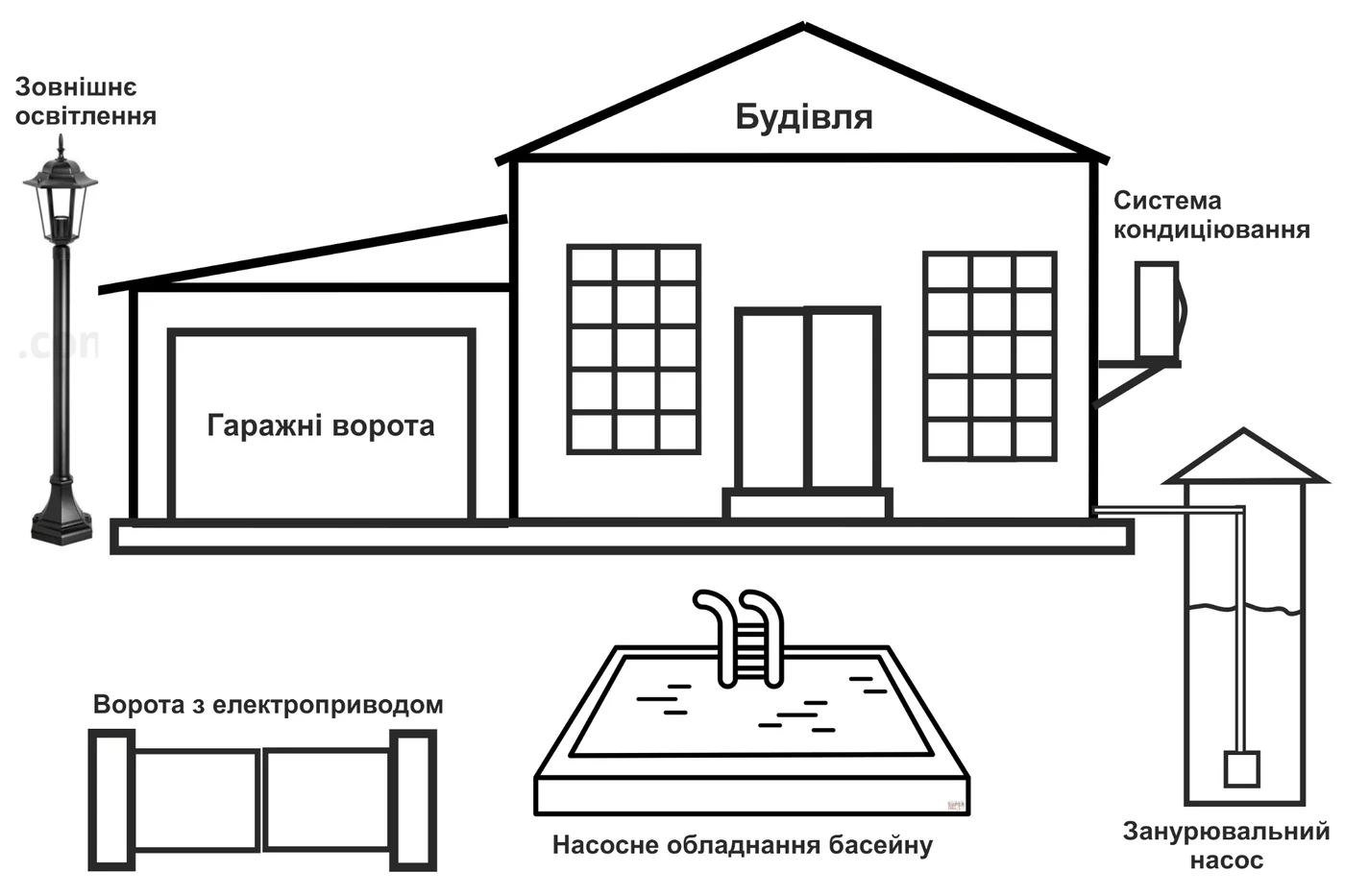
A surge can enter the home through the incoming power supply, outdoor lighting, garage doors, pumping equipment, air conditioning, communication lines, antenna cables and internet connections. Protecting only one socket or one switchboard therefore does not always provide the expected result.
3. Why one SPD is often insufficient
An SPD at the incoming supply can handle a substantial part of the energy of an external surge, but a voltage hazardous to electronics may still remain downstream. Some surges also originate within the facility, from motors, switching, variable-frequency drives, power supplies or other control equipment.
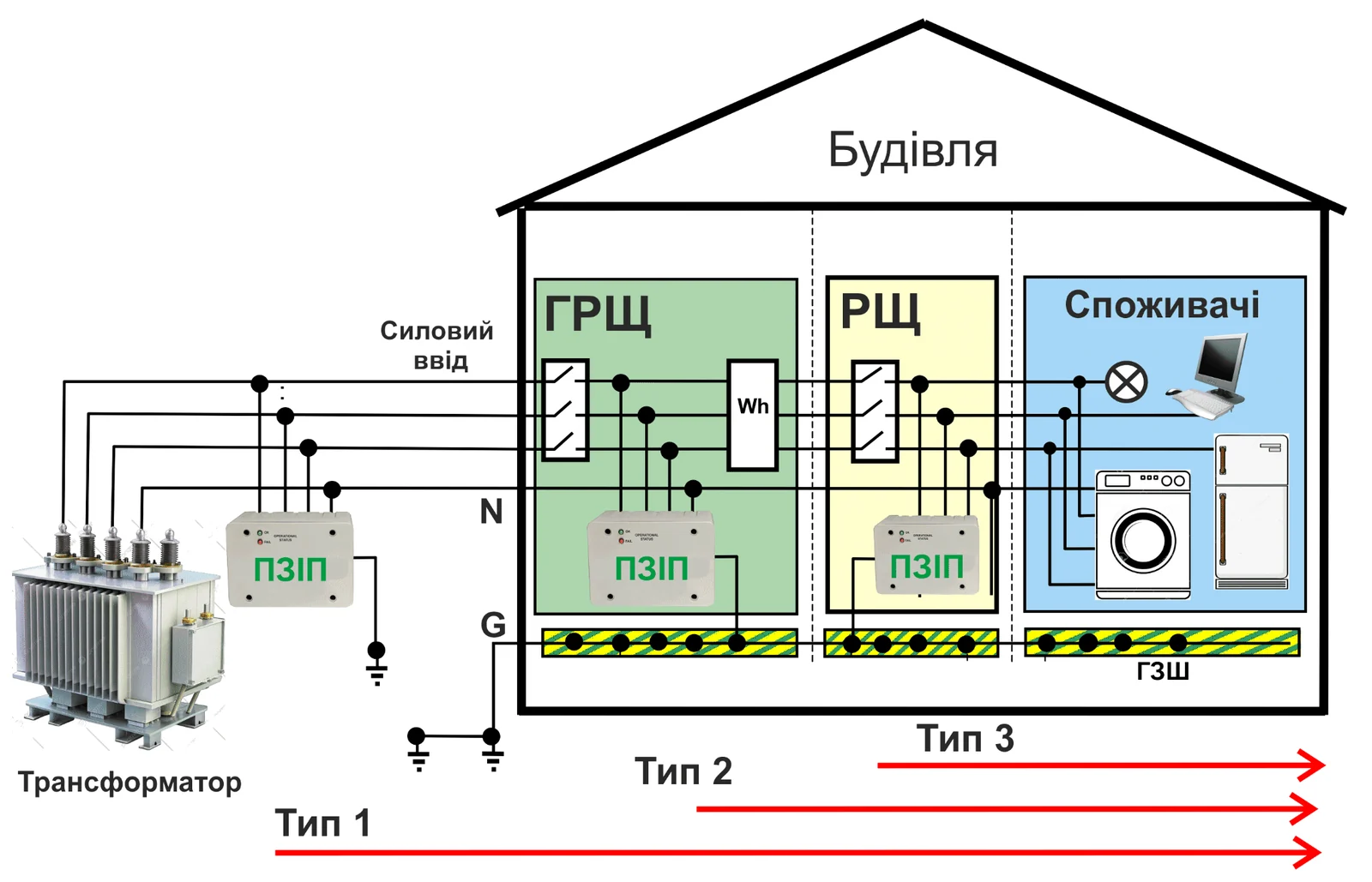
Reliable protection therefore uses a cascaded approach: the first stage at the incoming supply, the second in distribution switchboards and the third near sensitive equipment. The aim is not to install the largest SPD, but to distribute protection stages correctly throughout the building.
4. SPD types explained
| SPD type | Installation location | Main function |
|---|---|---|
| Type 1 | Near the power transformer, at the building incoming supply, in the main distribution or main LV switchboard, or near the external supply entry point | Handles the most severe surges arriving from the supply or induced by lightning. This is the first protection stage. |
| Type 2 | In distribution switchboards, standby power switchboards and near groups of important equipment | Reduces residual overvoltages after the first stage and limits surges originating within the facility. |
| Type 3 | Directly adjacent to sensitive electronics, controls, network equipment, servers or controllers | Provides additional protection for equipment that is sensitive even to brief voltage surges. |
5. Common SPD installation mistakes
One device for everything
An SPD at the incoming supply will not always protect a router, controller or control board elsewhere in the home. Voltage surges can originate both outside and inside the building during operation of pumps, compressors, air-conditioning units, electric motors and switch-mode power supplies. Sensitive equipment therefore often needs an additional protection stage closer to its location.
Long conductors
A long connection to the PE conductor or busbars increases the residual voltage at the equipment. For surges, connection geometry matters as much as the presence of an SPD.
Unsuitable voltage rating
The SPD must suit the nominal voltage and supply arrangement. Incorrect Uc selection can lead to premature degradation or emergency disconnection.
Selection by price alone
Budget always matters, but an SPD should not be selected solely by the lowest price. If the device does not suit the risk level, supply arrangement, earthing system, installation location and equipment sensitivity, it may fail to provide the expected protection during a severe lightning or switching surge.
Ignoring signal and communication lines
Internet, antenna, CCTV, gate and control circuits can carry a surge into the home just as readily as the incoming power supply.
Poor earthing
An SPD does not destroy a surge. It diverts surge current into the protective conductor system or between conductors. Without a correct PE system, protection becomes less effective.
No status monitoring
Varistor elements have a finite service life. For critical systems, SPD operational status indication or signalling should be provided.
6. What information is needed to select an SPD?
Correct selection requires more than the incoming supply current rating. An SPD is not a series-connected power switching device and is not selected like a circuit breaker according to the load operational current.
- supply type: single-phase 230 V or three-phase 400 V;
- earthing system and N / PE arrangement;
- installation location: incoming supply, main LV switchboard, distribution board, control panel or equipment;
- external circuits: gates, lighting, pumps, air conditioning, internet and antennas;
- presence of a generator, UPS, BESS, voltage stabiliser or ATS;
- whether status indication, a volt-free contact or signalling to a control system is required.
7. Conclusion
Surge protection in a modern home requires a system-wide approach. A correctly selected SPD at the incoming supply reduces the risk from external surges, SPDs in distribution switchboards reduce residual overvoltages, and local protection near equipment helps protect sensitive electronics.
The best result comes from a coordinated system: the correct SPD type, short connections, effective earthing, consideration of external circuits and protection status monitoring.
About this material
This article is based on ESL / STAVR technical material on residential surge protection, adapted to Ukrainian terminology, SPD installation practice, standby power systems and the STAVR approach to cascaded protection.