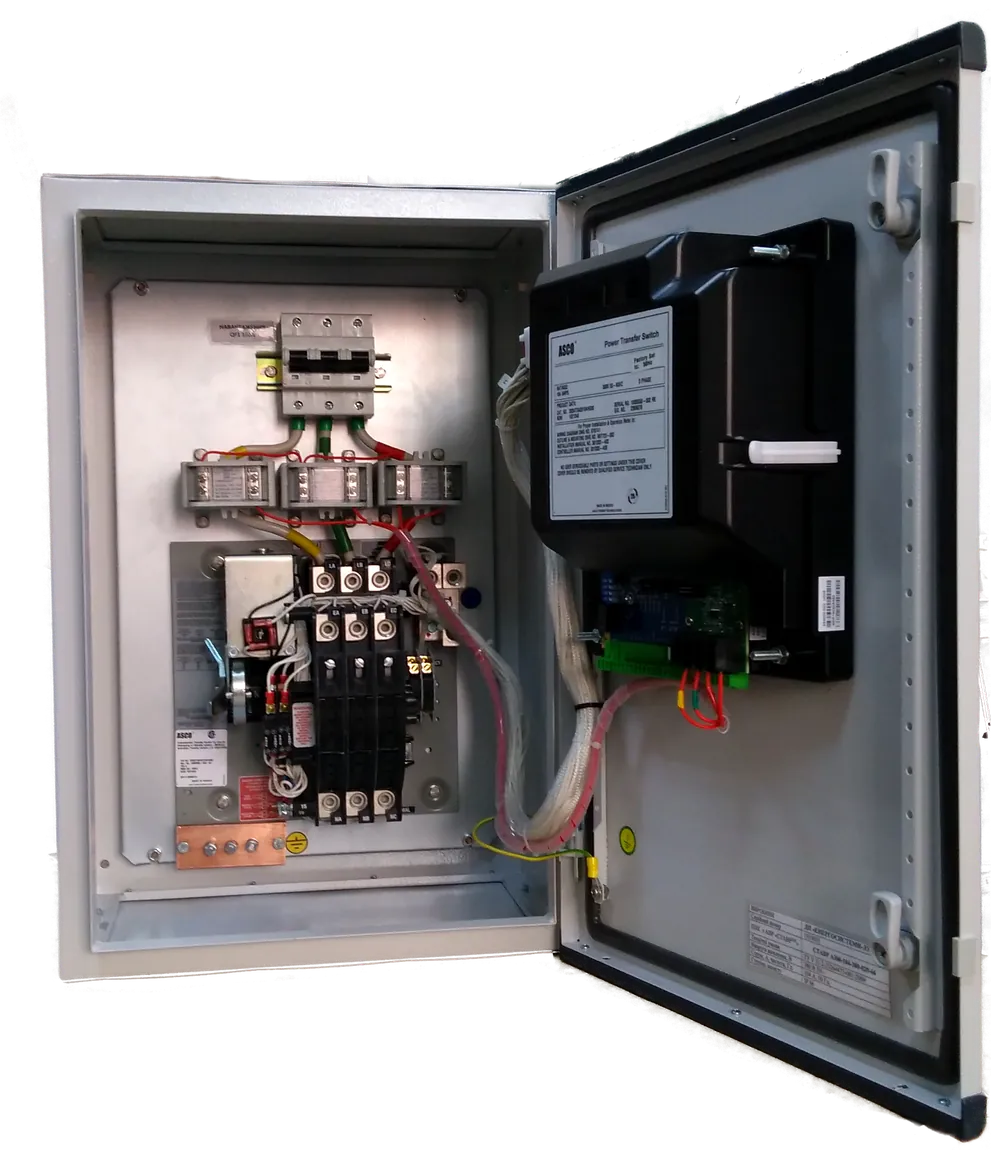
STAVR industrial ATS systems rated 100–4000 A are complete automatic transfer switch assemblies. We design and manufacture systems with two or three incoming sources for utility supplies, generators, UPS and BESS. Power switching equipment and transfer sequences are selected to meet the project specification.
Each STAVR ATS is selected for the specific power arrangement: utility/generator, utility/utility, generator/generator, UPS, BESS or a complex system with multiple incoming sources.
Solution overview
Solenoid operation in STAVR systems
For industrial STAVR ATS systems, we use two-position or three-position
switching mechanisms with a solenoid drive. When a transfer command is issued, the electromagnet produces a brief, powerful force that rapidly moves the power switching mechanism to the required position.
Solenoid-operated ATS designs combine fast response, simple mechanics, highly repeatable switching and reliability. This makes them suitable for industrial, commercial and infrastructure applications where both backup availability and fast, correct operation of the mechanism matter.
ATS switching mechanism designs
Depending on the backup power requirements, STAVR ATS systems use two-position (I–II) or three-position (I–0–II) mechanisms.
I ⇄ II
Two-position mechanism (I–II)
Rapidly transfers the load between the normal and alternative sources without a maintained centre position. Used where the power interruption must be kept to a minimum.
I — 0 — II
Three-position mechanism (I–0–II)
Has a maintained “0” position, in which the load is disconnected from both sources. The controller can command the mechanism to disconnect the load.
Protective functions of the three-position design. The controller can command disconnection if a source with limited capacity is overloaded, a phase is lost, phase imbalance is excessive, or voltage exceeds acceptable limits. These functions require the appropriate measurements, settings and controller logic.
Arc chutes — rapid arc extinction
STAVR ATS switching devices have arc chutes that extinguish the arc when the power contacts open, reduce electrical contact wear, and help interrupt the circuit quickly and reliably.
This is particularly important when transferring the load rapidly between two energised power sources.
Switching devices and standards
Class PC / AC-33B
IEC 60947-6-1 is the standard for transfer switching equipment. Class PC and the AC-33B utilisation category describe the switching device.
These characteristics must be verified in the documentation for the specific model selected for the ATS assembly.
ASCO 7000 Series / UL 1008
For assemblies based on ASCO 7000 Series , the design and UL 1008 certification are confirmed by the documentation for the relevant switching device.
UL 1008 certification of the switching device does not automatically mean that the complete ATS panel is UL-certified.
Control and monitoring
Safe transfer
Fast-transfer STAVR solutions use solenoid-operated Class PC switching devices, mechanical and electrical interlocks, power source monitoring and clearly defined control logic for safe load transfer.
Remote monitoring and control
Provided as part of the complete solution for the specific facility. Remote monitoring and control functions depend on the selected equipment and project specification.
In-phase transfer
Where an in-phase monitor is fitted, the controller tracks the phase relationship between the normal and alternative sources and identifies the moment for a fast transfer. This helps reduce switching transients affecting sensitive loads.
Transfer involves a brief interruption of power — the in-phase monitor helps reduce transient and inrush currents when running compressor, pump and other equipment motors are transferred between power sources, helping them continue operating without stopping.
STAVR is a complete low-voltage electrical assembly manufactured to Technical Specification TU U 31.2-25264473-001:2009, “STAVR low-voltage switchgear assemblies”.
Each product is manufactured as a complete solution for its facility, covering power switching, controls, interlocks, transfer logic, source monitoring, indication, remote monitoring and control, maintenance modes and technical documentation. STAVR products hold a certificate of conformity to DSTU requirements.
Quality management system
The quality management system of SC ENERGY SYSTEMS-LUDGER for manufacturing STAVR ATS panels and LV switchboards with ATS is certified to DSTU EN ISO 9001:2018 (ISO 9001:2015, IDT). View the certificate and scope of certification →
STAVR ATS features
Industrial backup power systems require more than an alternative source: transfer speed, reliability and repeatability also matter. Solenoid-operated ATS systems are therefore a suitable choice for critical facilities.
Fast transfer response for critical loads
The solenoid mechanism moves the power contacts rapidly using a brief electromagnetic pulse. This allows the load to be transferred promptly from the normal source to the alternative supply if the utility fails or becomes unstable.
In-phase monitor for fast-transfer ATS
For a fast open-transition transfer, the ATS monitors the phase relationship between the normal and alternative sources and waits for a safe transfer window.
This reduces switching transients affecting motors, UPS equipment, transformers, controls and other sensitive loads.
An in-phase monitor does not provide closed-transition transfer. It enables a fast transfer with a power interruption at a controlled moment.
Monitoring the phase angle between the normal and alternative sources before a fast ATS transfer.
Simple, reliable operating mechanism
A solenoid-operated ATS has fewer moving parts than a motor-operated design. Fewer mechanical components reduce the risk of wear, jamming and drive failure.
The robust drive mechanism maintains reliable switch operation even where voltage dips, repeated reconnections or unstable supply conditions occur frequently.
Reliability in systems with frequent transfers
Solenoid-operated ATS systems are well suited to applications with regular transfers between power sources. Dependable operation over repeated switching cycles matters in industrial facilities, commercial buildings, infrastructure and standby generator installations.
Low maintenance requirements and long service life
With their simple design and fewer mechanical components, solenoid-operated ATS systems require relatively little maintenance. Regular inspection, contact condition checks, checks of fastenings and basic cleaning are generally sufficient to keep the system operational.
Reduced wear on moving parts means lower operating costs and longer equipment life in long-term service.
Industrial and commercial applications
Solenoid-operated ATS systems can be used in factories, commercial buildings, hospitals, server rooms, telecommunications and critical infrastructure. They support different power configurations: utility/generator, utility/utility, generator/generator, UPS or BESS.
This approach provides design flexibility and reliable backup power operation where loss of supply is unacceptable.
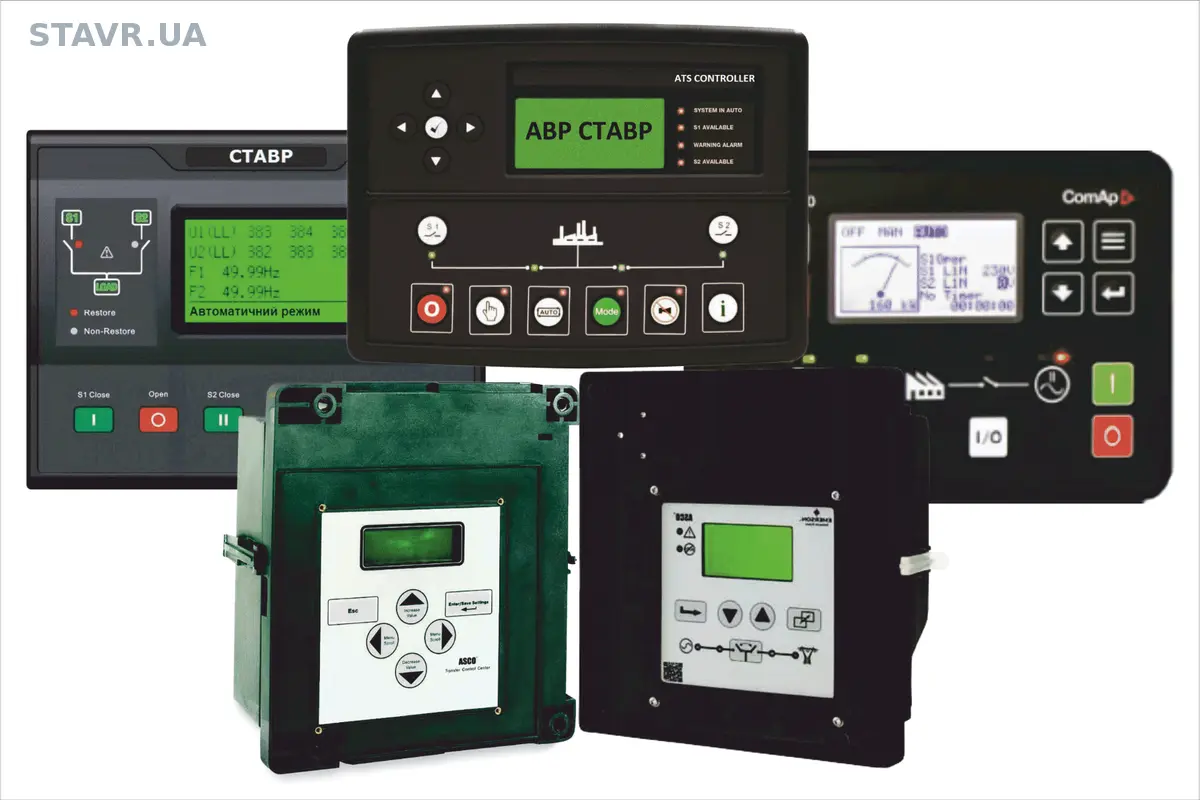
ATS controller
Controls for solenoid-operated ATS
Controllers for solenoid-operated Class PC ATS systems have a specialised set of functions. Unlike simple controllers for motor drives or contactor arrangements, they manage not only the transfer command but also source quality, permissive conditions, interlocks and the safe moment for switch operation.
The controller monitors the normal and alternative sources: phase and line voltages, phase imbalance, phase sequence, frequency and permissible operating limits.
Load current measurement
Current transformers monitor actual load demand: current, active power, reactive power and apparent power. The controller also protects the alternative source — a generator or BESS — against overload.
In-phase monitor
For fast open-transition transfer, the controller can track the phase relationship between the utility and the alternative source and permit transfer at a safe moment.
Prevention of unwanted transfers
Adjustable time delays filter out brief voltage dips and transient deviations so that the system avoids unnecessary transfers.
Event logging and diagnostics
Events, faults and operating parameters are recorded to analyse supply quality, identify the causes of emergency transfers and speed up troubleshooting.
Supervisory monitoring and integration
Industrial configurations can transmit data to a BMS or SCADA system over RS-485, Modbus RTU or other interfaces, depending on the selected equipment.
When an ATS is needed
An ATS is needed wherever loss of the normal supply puts equipment, processes, site safety or continuity of operation at risk.
generator backup power;
server rooms and critical infrastructure;
production lines, pumps and ventilation;
facilities with complex LV distribution or main switchboards.
What matters when selecting an ATS
Correct selection requires the load current, number of sources, number of poles, source types, neutral requirements, utilisation category and the sequence for returning to the normal supply.
More than a cabinet of circuit breakers
A properly engineered ATS is a coordinated system of power switching, controls, interlocks, indication and maintenance access, rather than simply a collection of devices in an enclosure.
ATS configurations
Explore the main application types below. Detailed product pages are available in English.
Customers need to understand how to assess transfer switching equipment: the applicable standard, utilisation category, endurance, interlocks and actual load operating conditions.
SPDs limit short-duration transient overvoltages in the power system. These surges can arise from lightning, switching of large loads, fault conditions or transfers between power sources.
SPDs are an important protection element for ATS, LV switchboards, generators, UPS and BESS, because surges can damage controllers, control boards, measurement circuits, power supplies and other sensitive electronic equipment.
In STAVR solutions, SPDs are selected for the facility power arrangement, protection category, earthing system, connected generators, UPS or energy storage, and requirements for maintenance and status indication.